


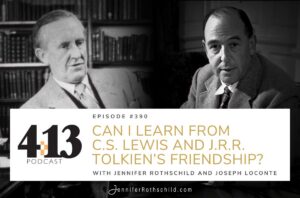
Today on the 4:13, historian Joseph Loconte takes us inside the lives and friendship of J.R.R. Tolkien and C.S. Lewis, two of the most influential Christian writers of the last century.
Amid the devastation of World War II, their imaginative writing provided a vision of reality—one grounded in truth, valor, and virtue. It’s through their stories that Tolkien and Lewis offered far more than escape, but a blueprint for resilience in times of crisis.
Joseph shares how looking at the world through their eyes can reveal the beauty and divine goodness that serve as an antidote to the lies, division, and hatred of our day.
Now… I may be a C.S. Lewis junkie, so I’ll confess I nerded out a little in this conversation! But whether you’ve read every word they wrote or barely know their names, you’ll enjoy this rich and insightful conversation about friendship, faith, and the power of story.
Meet Joseph
Dr. Joseph Loconte is an author, historian, and filmmaker who serves as director of the Rivendell Center in New York City. He’s a Presidential Scholar at New College of Florida and the C.S. Lewis Scholar for Public Life at Grove City College. He’s from Brooklyn, New York and is a frequent traveler to sunny Italy. He hosts the YouTube channel, History and the Human Story, and he’s also the author of the New York Times bestseller, A Hobbit, a Wardrobe, and a Great War.
Related Resources
Giveaway
- You can win a copy of Joseph’s book, The War for Middle-earth. Hurry—we’re picking a random winner one week after this episode airs! Enter on Instagram here.
Links Mentioned in This Episode
- Palm Beach Atlantic University
- The Logos Theatre
- Oxford, England Audio Pictures
- Jennifer’s Brand of Tea: Mere ChristianiTea
More from Joseph Loconte
- Visit Joseph’s website
- The War for Middle-earth: J.R.R. Tolkien and C.S. Lewis Confront the Gathering Storm, 1933–1945
- Follow Joseph on Facebook and Twitter
Books by C.S. Lewis and J.R.R. Tolkien
- C.S. Lewis: Mere Christianity, Surprised by Joy, The Screwtape Letters, and The Chronicles of Narnia
- J.R.R. Tolkien: The Hobbit and The Lord of the Rings
Related Episodes
- Actor Max McLean on C.S. Lewis and the Most Reluctant Convert [BONUS]
- Can I Tune Into Eternity Even Now? With Amy Baik Lee [Episode 309]
- Can I Figure Out Friendship As a Grown-up? With Lisa Whelchel [Episode 155]
Stay Connected
- Don’t miss an episode! Subscribe to the 4:13 Podcast here.
- Were you encouraged by this podcast? Reviews help the 4:13 Podcast reach more women with the “I can” message. Click here to leave a review on Apple Podcasts.
Episode Transcript
4:13 Podcast: Can I Learn From C.S. Lewis and J.R.R. Tolkien’s Friendship? With Joseph Loconte [Episode 390]
Joseph Loconte: The other thing that Tolkien and Lewis are doing is they are using the existing crisis that they're in and they're turning around and they're using it for good. And they're offering a hopeful vision of the human story at a time when many men and women, particularly after the First World War, had become deeply disillusioned, cynical, morally agnostic. They had rejected any kind of basis -- rational basis for hope.
And these two men are using this disastrous situation, yes, the First World War, but particularly now the Second World War, the sense of urgency that they must have felt, because it's an existential crisis for Great Britain during World War II. And they're using the crisis of that and they're pushing back. And they're saying, even in the midst of this crisis, the choices of individuals matter.
Jennifer Rothschild: During a season when the world was devastated by war, two authors and friends, J.R.R. Tolkien and C.S. Lewis, gave us a path back to goodness, beauty, and faith. So how did they do it? Well, on today's episode, historian Joseph Loconte is going to explain how the catastrophe of World War II transformed the lives and the literary imaginations of Tolkien and Lewis.
Now, I got to say, I admit, I did nerd out a little bit in this conversation. But you do not have to know these authors or what they wrote to enjoy this life-giving, funny, and insightful conversation about their lives and their friendships. The good professor will show you a Christian vision of our earthly journey through the eyes of Lewis and Tolkien and you will get a glimpse of divine goodness and truth that will serve as an antidote to lies and to hate. Oh, it is just what we need for our day.
So, KC, it's time to nerd out. Here we go.
KC Wright: Let's go. Welcome to the 4:13 Podcast, where practical encouragement and biblical wisdom set you and I up to live the "I Can" life, because you can do all things through Christ who strengthens you.
Now, welcome your host, Jennifer Rothschild.
Jennifer Rothschild: Yes, it's so good to have you guys back with us again. And listen, whether you're a C.S. Lewis geek or a Tolkien geek or not even a geek at all, like, no matter where you are, I'm telling you, this is such a life-giving, funny conversation. First of all, Joseph Loconte is a historian, and he's a professor, and he's hilarious. And he's Italian and he can hardly contain his energy. Okay? So he's funny just to -- he's so engaging. You're going to love this conversation.
But what I think you will get as a takeaway is something all of us can relate to, whether you're literary or not, and that is friendship and how we make each other better through friendship and how friendships and solid, cohesive relationships that are based on Christ and biblical truth can change our world.
KC Wright: So good.
Jennifer Rothschild: So tune in and stay with us, because you are just about to love this.
Now, I will tell you this.
KC Wright: Yes.
Jennifer Rothschild: C.S. Lewis --
KC Wright: Yes.
Jennifer Rothschild: -- he's, like, with me and KC all the time.
KC Wright: All the time.
Jennifer Rothschild: I admire J.R. Tolkien, but, like, I really connect with Lewis.
And KC and I were talking. We both didn't know we did this. But we both went and saw -- it was in December, I think.
KC Wright: Yes, December, in Branson.
Jennifer Rothschild: The Logos Theatre.
KC Wright: Of Narnia on stage.
Jennifer Rothschild: They did Lion, Witch, and Wardrobe, and they did such a good job.
KC Wright: I was center, front row in the center, and it was perfect --
Jennifer Rothschild: It was.
KC Wright: -- amazing.
Jennifer Rothschild: It was word perfect.
KC Wright: It was just phenomenal.
Jennifer Rothschild: Yeah. So if you've not ever seen anything by the Logos Theatre, oh, highly recommend. But you need to watch The Lion, Witch, and Wardrobe with some Turkish delight.
KC Wright: Yes. Elly and I did that over Christmas. We had a C.S. Lewis Christmas --
Jennifer Rothschild: Oh, you did?
KC Wright: -- where we watched all three movies back to back.
Jennifer Rothschild: Oh, my gosh. That's awesome.
KC Wright: Well, you know, a couple days in between. But we so enjoyed it. I love it that my girl is into C.S. Lewis.
Jennifer Rothschild: I do too.
KC Wright: So Jennifer has made an impact on me with C.S. Lewis, therefore rubbing off on my daughter, and so we are all majorly C.S. Lewis geeks now. And I just was -- I did a deep dive over Christmas into his life, and C.S. Lewis remained single -- did you know this? -- until he was 58 years old --
Jennifer Rothschild: Yes, I knew this, of course.
KC Wright: -- where he married a woman named Joy Davidman in 1956. So most of his life he assumed he would never marry, and even wrote skeptically about romance, then unexpectedly love found him later in life. And their relationship deeply shaped his later writings, especially "A Grief Observed" after Joy's death.
So anyway, just a powerful reminder to those of you listening that God's timing isn't rushed, calling and fruitfulness aren't limited by age, and some of the most meaningful chapters open late in life.
Jennifer Rothschild: KC, that's a very good word.
KC Wright: So Lewis himself said Joy brought him a happiness "I had never dreamed of."
Jennifer Rothschild: Well, and you know what? It wasn't just a gushy romance. She was his intellectual equal. Which it's not easy to find an intellectual equal. Except, of course, J.R.R. Tolkien was too.
Okay. I'm just saying, enough from us. Let's hear from the historian, the professor, the expert, Joseph Loconte.
KC Wright: Dr. Joseph Loconte is an author, historian, and filmmaker. He serves as Director of the Rivendell Center in New York City. He is a presidential scholar at New College of Florida and the C.S. Lewis Scholar for Public Life at Grove City College. He's from Brooklyn, New York, and he's a frequent traveler to sunny Italy. He hosts the YouTube History channel "History and the Human Story." I'll say that again, because you need to go to YouTube and find it.
Jennifer Rothschild: Yep. Right?
KC Wright: It's called "History and the Human Story." He is also the author of the New York Times bestseller, "A Hobbit, A Wardrobe, and A Great War," and his new release, "The War for Middle Earth," which is the book he and Jennifer are talking about today.
So get ready, get comfy, get smarter.
Jennifer Rothschild: Yeah.
KC Wright: Right?
Jennifer Rothschild: Right.
KC Wright: This is what is about to happen. Okay, here we go. Dr. Joseph and Jennifer Rothschild.
Jennifer Rothschild: All right. I am so excited -- I told you off mic that I'm so excited that we get to have this conversation, Dr. Loconte, and so we're going to start with this. Most everyone listening, you know, they know who Lewis and Tolkien are, but that may only include knowing a little about them. Like, they may not really know. So I think we need to start with that, with some introductions.
Who are these two men? And then also give us a picture of what their life was like, what their world was like in Oxford, England, at the time.
Joseph Loconte: Yeah. Thank you, Jennifer. Great to be with you.
You know, these are two of the most important Christian authors of the last 100 years, without exception. And what both of these men did was to reintroduce into the modern mind the concept of the epic hero. And the reason that's so significant is because they're living in a time, they're coming of age in the 1920s and 1930s and right into 1940s, when the whole concept of individual heroism, virtue, faith, it is being deeply challenged by the various ideologies that they are awash in in that period during the 20th century.
When I say ideologies, I mean things like Fascism, Nazism, Communism, Totalitarianism, eugenics, scientism, materialism, all of these ideas that are so contrary to the Christian understanding of the human person. And Tolkien and Lewis have come of age as scholars, as authors, in the midst of this ideological fight, this battleground.
Jennifer Rothschild: Well, and some people may not know that Oxford -- I mean, they think of Oxford, England, as a town. But it's also a university. So tell us about that and what life was like, therefore, in Oxford when these two guys were coming of age either as students or professors.
Joseph Loconte: Yeah, They both studied and got their degrees at Oxford in English literature. They both fought in the First World War. Tolkien in 1916 at the Battle of the Somme in France. C.S. Lewis arrived on the battlefields of France on his 19th birthday in 1917. They both survive, but they lose most of their closest friends in that battle, in that war.
And so here it is, these guys, they fought in the First World War. They didn't know each other then. They meet each other at Oxford when they return to Oxford to begin their academic careers. They meet in 1926, as far as we know, for the first time at a faculty meeting. And, Jennifer, if you think about the impact that these two men have had through their writings on millions of people around the world throughout the decades, that was probably the most important faculty meeting in the history of faculty meetings.
And they don't start out as friends, but they pretty quickly become friends because of their shared love for epic literature and myth. And, of course, eventually their common Christian faith is going to bind them even more closely together.
But Oxford in the 1920s, this was a university that had -- in a sense it had been through the war. So many of its young men had gone off to fight and never returned. So it's recovering academically now as a premier university in the world, and these two men are there now, both chasing their professions in the 1920s as scholars of English literature.
Jennifer Rothschild: Well, and we could also say that's one of the most productive faculty meetings ever.
Joseph Loconte: Exactly right.
Jennifer Rothschild: But here's the thing. Some listening may not realize the faith impact that Tolkien had on Lewis, because some may believe that Lewis just grew up a Christian. Tolkien, I believe -- I don't know him as well. I believe he was a Catholic believer, very strong faith. Give us just a picture and even maybe take us to Addison's Walk. Let us understand that part.
Joseph Loconte: Wonderful question. And, you know, there are many influences on C.S. Lewis' life. You can read about those in his autobiography, "Surprised By Joy." Many voices spoke into his mind over a period of years.
Because remember, Jennifer, when he went into the First World War, he was an atheist. He was an atheist in a foxhole literally. And his poetry in 1919, a book of poems, "Spirits In Bondage," he is raging against the God of the universe. "Let us curse our Master ere we die. The good is dead. Let us curse God most High." That's C.S. Lewis in 1919. So he remains an atheist through the 1920s. He begins to kind of shed his very militant materialism and is open to maybe spiritual influences. He becomes more of an agnostic. By the time he meets Tolkien, he's really on a faith journey.
And then by the time you get to 1931, as these two men have become great friends, they have this discussion -- let's call it a debate really -- after they have dinner. And another friend joins them, Hugo Dyson. The three of them are walking along this footpath called Addison's Walk. And I've been there. It snakes along the river there in Oxford. And they start having a debate about myths and the meaning of myths. Because both of these men, Tolkien and Lewis, are really drawn to these ancient mythic stories, the Greek and Roman myths, Beowulf. They love these big epic stories with this idea of sacrifice.
And the problem -- the hang-up for Lewis is he thinks that Christianity is just like these ancient pagan myths, that there's no truth to it, it's just made-up stuff. There's no truth value.
And what Tolkien helps him to see is, now, wait a minute, the things -- he says to Lewis, the things that you love in these older myths, this idea of nobility and virtue and sacrifice, these elements, they are intimations of a greater story, a true story, a true myth. Christianity, the myth that became fact. The God man in Jesus comes to earth, dies for our sins, rises back to life to open up a path to heaven for us. That's the myth that became fact. And all these other great stories that you love, Lewis, they are splintered fragments of the True Light.
That is the intellectual breakthrough for C.S. Lewis, Jennifer. I think only -- this is in the grace and the mercy of God.
Jennifer Rothschild: Yeah.
Joseph Loconte: I think only J.R.R. Tolkien, because of his intelligence, because of his friendship with Lewis, I think he's probably the only person on earth who could have spoken to him at that moment and taken down his prejudices against Christianity. Because it's just within a matter of days that he really converts to Christianity, becomes a believer as he writes about to his brother, and then later in his autobiography. It is a pivotal transformational conversation.
Jennifer Rothschild: It blows my mind. And it's a reminder to us as believers in Christ to never shy away from debate, to never shy away from someone who seems like they're not really interested in anything but a fight. Love them, walk with them --
Joseph Loconte: That's right.
Jennifer Rothschild: -- and see what God does.
Okay. So obviously this friendship -- and we're going to talk a little more about this. But this friendship changed -- well, God used it to change C.S. Lewis' life. But it also impacted their works. And we're going to talk about that. But before we do, I want to talk about Tolkien first. And he's not my guy. I'm not as familiar with him. But I know people love him. I've tried. I just haven't gotten there yet. I love him as a person. I just haven't gotten into his writing yet.
So I want us to understand him a little better. I want to know how his experiences in World War I show up in, like, his epic work "The Lord of the Rings."
Joseph Loconte: Yeah. In numerous ways. And then also the Second World War, which also works very powerfully on his imagination, I think, in general.
But let's take the First World War. For those Tolkien fans out there -- and if you've seen the movies, you'll get some of this too. The attempt to destroy the ring, Sam and Frodo in the Dead Marshes. And there's a scene there in the movie, and also in the book, where Sam falls on his face into the marsh and he sees these dead faces in the water. Dead faces. It's this hideous kind of scene.
And you think it's just complete fantasy, but it's not. Because anybody who served -- any British soldier who served in France, particularly at the Battle of the Somme, that soldier would have encountered men, soldiers dead in pools of water, large craters that would have been created from the mortars, the powerful artillery. And those bodies would lie there for days or weeks at a time and you would just discover them.
So that literary image, it has to be drawn from an actual war experience. That's just one example.
Another I'll give, though, which really got me thinking about these two men and the impact of war on their lives, Tolkien says explicitly that his Sam Gamgee is based upon the ordinary English soldier with whom he served during the First World War "and considered so superior to myself." So think about it.
Jennifer Rothschild: Wow.
Joseph Loconte: One of the most beloved characters in all of modern fiction, "The Hobbit," is based on the ordinary English soldier doing his bit for king and country there in a trench. Wow.
Jennifer Rothschild: Right.
Joseph Loconte: Wow. Heroism, right?
Jennifer Rothschild: That makes me want to read it again. Yeah, that makes me really want to read it differently. I love that.
Joseph Loconte: Yeah. It's so impressive. Go ahead.
Jennifer Rothschild: Okay. So I was also thinking -- and I'm glad I'm talking to you because you'll know. Maybe it was in "Surprised By Joy" where C.S. Lewis describes these men like crushed beetles --
Joseph Loconte: Yes.
Jennifer Rothschild: -- in the war. I mean, they saw devastation that we can't conceive of.
Joseph Loconte: Yes. It was heartbreaking. And this is what kind of takes you back to the Second World War. I think it's so important for your audience and for people who love Tolkien and Lewis to realize that their lives were bracketed by two global conflicts. And there's no one alive who can tell us anything about that, right? So 20 years after the First World War, they have to endure a Second World War.
And here's an excerpt, if I could, a quick excerpt.
Jennifer Rothschild: Yeah, please.
Joseph Loconte: Tolkien wrote a letter to his son Michael. His oldest son is serving in the British military. He's an anti-aircraft gunner. This is in 1941. And his son is understandably anxious about his own life. You know, is he going to survive?
And here's what Tolkien writes to his son Michael. "I never expected to survive," thinking about his own war experience, "and the intense emotion of regret. The vivid perception of the young man who feels himself doomed to die before he has said his word is with me still. A cloud, a patch of sun, a star were often more than I could bear."
I mean, think about the poignancy of that. What he's sharing his raw emotion with his son of I'm not going to get to finish. My life is going to end in this trench or under fire here now. I'm not going to get to taste again what it means to be a human being, to experience beauty.
I mean, that's what life was like for these men, not only in the first World War, but even more so during the Second World War. And that's really what my second book is about, "The War for Middle Earth," how did the cataclysm of that war press upon their imaginations?
Jennifer Rothschild: Okay. Well, let's move there. And by the way, those were -- just hearing you read them, I felt the weight of them. Those are heavy words.
So let's move to the Second World War and to Lewis, "Mere Christianity." Okay. That book that we all love, "Mere Christianity" it's based on wartime addresses.
Joseph Loconte: Of course.
Jennifer Rothschild: So tell us about that and what the impact of those broadcasts had on Britain. Because you just talked about the morale of soldiers. What about the morale of Britain? And how did his radio addresses impact his morale? And I'm curious, did those radio addresses impact other writing besides "Mere Christianity"?
Joseph Loconte: Those are fabulous questions. Let me take a stab at it, Jennifer, and remind our audience here. Okay, this is England. England's at war. 1939 is the beginning of the Second World War. America is on the sidelines until Pearl Harbor at the end of 1941. So Britain is hanging by a thread. Let's keep the context in mind. It's an existential struggle for Great Britain because everyone's expecting an invasion at any moment from Nazi Germany. That's what they're bracing for.
So it's in the midst of that that the religious director of the BBC, he goes to C.S. Lewis -- because he's read C.S. Lewis' book "The Problem of Pain, and he thinks, you know, this guy can communicate Christian truth to a broad audience. Let me get him to do a series of radio broadcasts explaining and defending the Christian faith. That's what the BBC was willing to do --
Jennifer Rothschild: Remarkable.
Joseph Loconte: -- in 1941.
Jennifer Rothschild: Remarkable.
Joseph Loconte: Well, how far they have fallen, right?
Jennifer Rothschild: Yeah.
Joseph Loconte: But that's where they were in 1941-42.
So they go to Lewis, who doesn't even really listen to the radio. He's not inclined to do this, this is not his medium, but he decides, no, this is an opportunity. I'm going to get out of my comfort zone and I'm going to do this. He travels from Oxford to London by train, not without risk to himself, Jennifer, because the Nazis are still bombing London and the BBC has been bombed several times.
So here he goes to do his broadcast. Fifteen minutes is what he gets, 8:45 to 9:00. How does he start his broadcast in Anglican England in 1941-42? How does he start his -- here's the opening line, Jennifer, which is the opening line of "Mere Christianity." The opening line is, "Everyone has heard people quarreling." "Everyone has heard people quarreling."
Now, what do we do when we quarrel? Well, we say things like, you know, "You told me you were going to do that, and you didn't. You broke your promise." "Hey, you took a piece of my pie. Give it back." We appeal to a standard, a moral standard that the other person seems to be violating. And we realize that we ourselves violate our own standards.
But the point is, we appeal to an absolute, an absolute moral standard. That's where Lewis has to start in Anglican England because it's so secular. He can't start with Jesus. He will take his audience to Jesus, but he can't start there. That's maybe something we should think about now --
Jennifer Rothschild: Right.
Joseph Loconte: -- 80 years later -- right? --
Jennifer Rothschild: Right, right.
Joseph Loconte: -- as we try to reach people with the Gospel.
But the point is, those broadcasts become "Mere Christianity." They're put together in that book, which most people would say probably the most influential work of apologetics in, like, the last 200 years, right? But it was produced in a period of absolute civilizational crisis. Will Great Britain even survive the war? That's Lewis living out his vocation, because he cares deeply about people and he cares about the Gospel.
[PARTNER INTRO - Palm Beach Atlantic University]
Jennifer Rothschild: Some of my favorite memories from my time as a student at Palm Beach Atlantic University are the times that we pulled out guitars and just sang together. We sang praise songs sitting around in the courtyards or in the dorms, and even sitting on the sea wall overlooking the Intracoastal Waterway. And Phil and I, we were just there last February and, listen, there were those students. They were still gathered, and they were playing their guitars and singing praise songs. What a very special place.
At Palm Beach Atlantic University, you can be part of something very special. The Christ-first community at PBA creates bonds that nurture, inspire, and last an entire lifetime. Besides that, you get a world-class education on top of that. So you need to check it out and learn more about this university where I graduated, Palm Beach Atlantic University. You can go to 413podcast.com/PBA.
All right. Now let's get back to our conversation.
Jennifer Rothschild: You know, I'm curious too. My understanding is that in his academic circles, he was respected as a medieval scholar, but he was not respected by his colleagues with his imaginative works. I'm curious, how -- do you know how that went over when he's on BBC talking about Christianity?
Joseph Loconte: That's a great question. I think -- we have to read a little bit between the lines. But I think there was a real professional jealousy and kind of a condescension that he experienced from his colleagues. And not from Tolkien on this, but from his other colleagues who are not Christians. You know, why is this academic, who's supposed to be doing academic work -- who does he think he is trying to educate us about Christianity, which, by the way, is a mythological belief system anyway? That's what his peers are thinking.
Jennifer Rothschild: Right, right. Wow.
Joseph Loconte: And I think we can conclude this because Lewis was never offered a full professorship at Oxford. He got that at Cambridge. It's one of the reasons he left Oxford to go to Cambridge in the 1950s. So I think there was this professional envy and jealousy and condescension that he had to battle against as his Christian credentials became more obvious. He's really believing this stuff that the Christians have been talking about for 2,000 years, and most academics at Oxford, at least many, they don't.
Jennifer Rothschild: Right, right. I think that's such an example of humility --
Joseph Loconte: Yes.
Jennifer Rothschild: -- of the sacrifice of the call. You just do -- you just do and let the chips fall as they may. But, you know --
Joseph Loconte: That's exactly right.
Jennifer Rothschild: -- Oxford's loss anyway.
Joseph Loconte: That's right.
Jennifer Rothschild: Okay. So Tolkien and Lewis, you mentioned earlier during their lifetime they saw the rise of such, you know, Totalitarianism, Fascism, et cetera. Okay. So how do you think that shaped -- or do you think that shaped the way they portray evil --
Joseph Loconte: Oh, yeah.
Jennifer Rothschild: -- in their fantasy worlds?
Joseph Loconte: Oh, that's a fabulous question, Jennifer. Let me give you a very concrete example. 1940, summer of 1940 -- and by now, all of Western and Central Europe is under Nazi control. France has fallen. Britain is still alone in this, and the Battle of Britain has just begun to rage, the Nazis trying to take over Britain. And Hitler gives a triumphant speech, and it's broadcast over the BBC. It's simultaneously translated into English. Guess who's listening to that Hitler speech in 1940? C.S. Lewis. He's listening to it with his doctor friend, Dr. Havard. And when Lewis writes to his brother the next day, he says this. He says, "I don't know if I'm weaker than other people, but while the speech lasts, it is almost impossible not to waver just a little."
Jennifer Rothschild: Oh.
Joseph Loconte: Wow.
Jennifer Rothschild: Yeah.
Joseph Loconte: This is C.S. Lewis we're talking about.
Jennifer Rothschild: Wow.
Joseph Loconte: This is not some gullible personality. And he finds himself drawn into the propaganda and the power of this message from this man who is demonic. So what happens now? That's a Friday.
What happens on Sunday? Lewis is in church. The sermon is going on and on and Lewis starts thinking about the devil. Now, I don't know how bad the sermon was, but he starts thinking about the devil. And he gets the idea -- as he writes to his brother, he gets the idea of a diabolical fantasy, with a senior demon corresponding with a junior demon about how to capture a human soul and drag it into perdition. He calls his book "The Screwtape Letters."
Jennifer, I don't think it's any accident that on a Friday he hears this broadcast from Hitler, on Sunday he starts thinking about the devil in "The Screwtape Letters." And the amazing thing -- back to your question. How is he going to portray evil? Yes, there's evil outside of us, and it can actually capture entire regimes, like Nazi Germany, but there's evil in us, right?
Jennifer Rothschild: Ooh. Right.
Joseph Loconte: We are fallen creatures, and there's darkness all around and within us. And that's what "The Screwtape Letters" is about, isn't it? It's kind of a moral diagnostic every time you read it.
Jennifer Rothschild: Yes.
Joseph Loconte: So that is one of the ways in which the evil that's going on outside on the battlefield -- there's a war of ideas, there's a war for the souls of men and women, and that's going on all the time regardless of the battle out there in Europe or in France or wherever. That, to me, is such a powerful lesson for all of us, isn't it?
Jennifer Rothschild: Huge. And it's easy to focus on the out-there evil. But if we disregard the potential for our own corruption, then it doesn't matter what's happening out there.
Joseph Loconte: Yes. And think about it. Let's think about Tolkien now. Same for Tolkien in "The Lord of the Rings." You know, what does the ring represent?
You know, when the book was published, when "The Lord of the Rings" was published in the early 1950s -- and, you know, by that time, we're into atomic power and there's an arms race going on. So a lot of people assumed that "The Lord of the Rings," that the ring itself, it's really just kind of a metaphor, a symbol for atomic power.
And Tolkien sets them straight. He says, of course, the ring is not a metaphor for atomic power, but of power exerted for domination. He tells us what the book is about. It's about power exerted for domination. Well, that's exactly what they saw from their vantage point in Great Britain, the rise of these Totalitarianism states.
But also, of course, what is "The Lord of the Rings" about? It's about our ability, the capacity to be drawn into that evil. Just the lusting for power, the lust to dominate, right? That's our problem. That's not somebody else's problem, right?
Jennifer Rothschild: Right. And that's what creates the problems.
Joseph Loconte: Exactly right.
Jennifer Rothschild: Wow.
Joseph Loconte: That's what's so important about these authors. Yes, they're aware of the global conflict, the cataclysm that's going on around them. You can't avoid it. And I think it influences their writings. But both men in their writings are trying to draw attention to the inner struggle, the struggle for our own souls.
Jennifer Rothschild: Wow. I just love that both of them are so circumspect.
Joseph Loconte: Yes.
Jennifer Rothschild: That's just part of the humility and brilliance of both of their lives. So here I'm curious listening to you. You're clearly a scholar who knows so much more than most of us have even ever thought about with these guys.
So I'm curious in your research, for any of the books or even for this book, is there anything that surprised you? Like, did you learn anything different or go, like, "Wow, I had no idea," when you were researching this? Maybe their letters or their wartime correspondence?
Joseph Loconte: Well, it's a wonderful question. There were many, many things that surprised me, Jennifer. Let me just mention one.
I didn't appreciate how -- because these men were scholars and they were rooted in the classical medieval Christian tradition, the great epic works of Western civilization: Homer, Vergil, Dante, Milton. This is their intellectual furniture. They didn't think of these great stories from a vacuum. If they don't have that intellectual foundation, you don't get "The Hobbit," you don't get "The Lord of the Rings," you don't get "The Space Trilogy," you don't get "The Chronicles of Narnia" without that great classical Christian inheritance.
And I'll give you one example of this. One of the students of Tolkien and Lewis, a woman named Helen Tyrrell Wheeler, she writes this little reflective essay about her time with them. It's so impressive to read from this young woman during the Second World War, sitting in on their classes where they're teaching Beowulf. Lewis is teaching about Vergil's "The Aeneid." And here's how she described the impact of their teaching on her. Here's what she said.
"Well, what it meant for my generation of English language and literature undergraduates was that what happened in the great books was of equal significance to what happened in life. Indeed, they were the same."
Now, think about that. What happened in the great books was of equal significance to what's happening in life, the war that we're in right now. What does she mean? It's so perceptive. I think she means that the truths about the human condition that are embedded in those great works about virtue, about heroism, about betrayal, about sin, about redemption, those great truths embedded in the great works of Western civilization, they speak to us now in the present crisis. What a perceptive young woman, right?
Jennifer Rothschild: Yeah.
Joseph Loconte: That was a surprise for me. I didn't anticipate how these men were able to bring together this classical Christian tradition. In their teaching, yes; in their scholarship; but then, of course, through their imaginative works. There's no one -- they have no rivals. They have no peer in their ability to do that, to bring those things together.
Jennifer Rothschild: No. Which is why they still stand as giants and why we still -- every time I read anything -- like I'm re-reading Narnia right now leading up to Advent -- I'm sorry -- Easter. A book a month. And I've read them before, and every time it's just like, wow, there's more, there's more, there's more, because it's so embedded and woven in.
Joseph Loconte: Yes. That's right.
Jennifer Rothschild: Okay. So there's a concept you write about, that I'm going to mispronounce, so you're going to need to correct me, Professor. And then you're going to need to tell us what it is. Okay. Eucatastroph.
Joseph Loconte: Oh, yeah. You're close. Eucatastrophe.
Jennifer Rothschild: Eucatastrophe. Okay.
Joseph Loconte: Eucatastrophe.
Jennifer Rothschild: All right. What is that? What is that, and how does that show up in their lit?
Joseph Loconte: Well, this is a phrase that Tolkien invented. And what he means by it is the undoing of a catastrophe, the reversal of a catastrophe. And another way he described it was a sudden miraculous grace. And you see this, of course, in "The Lord of the Rings."
Now, this is a spoiler alert for your audience now, Jennifer.
Jennifer Rothschild: Okay. We're warned.
Joseph Loconte: Okay. You know, Frodo, at the end of the day he doesn't really succeed in his quest, does he? Not fully. Because at the end of the story, what does he do at the Cracks of Mount Doom? He says, "I shall not do what I came to do. The ring is mine," and he puts it back on his finger. And then Gollum, this hideous creature, this self-absorbed creature who desires the ring, bites his finger, bites it off of him. Just grabs the ring by biting it off of his finger. And then Gollum slips and falls into the Crack of Doom and the ring is destroyed.
And that's the eucatastrophe. The catastrophe is Frodo is about to fail in his quest. He's gone all this way with his great companion, Sam, to try to take the ring and destroy it. And at the end, he succumbs. But then at the end there's a reversal, a eucatastrophe, a sudden miraculous grace. I mean, it's right -- it's the Gospel.
Jennifer Rothschild: It is the Gospel.
Joseph Loconte: We need a force outside of us to save us from the great evil. We can't save ourselves.
And think about "The Chronicles of Narnia." You know, the children at the end of the day in the last battle -- again another spoiler alert, Jennifer.
Jennifer Rothschild: That's okay. You're on a roll. Keep going.
Joseph Loconte: The children do not save themselves from the demon Tash, right? Aslan has to save them. Aslan has to break in, break in and lead the way to Narnia, that great kingdom beyond the sea.
So a sudden miraculous grace. All hope is lost despite all of their efforts, despite all of their heroism and their struggle, which they're required to do. They are called upon to be brave and heroic and to fight against evil, but in the end they cannot defeat these dark forces on their own. They need grace, grace outside of themselves, of course, the grace of Christ ultimately at the center of their stories. Both their stories, I would say.
Jennifer Rothschild: And all of our stories. That is what we need. May it be, Lord.
Joseph Loconte: Yes. Beautiful.
Jennifer Rothschild: Okay. So some are listening right now, and they're creatives. They want to write or whatever artist. I'm curious, in your opinion what can a creative learn from how Tolkien and Lewis used their creativity back in the day?
Joseph Loconte: Wow, what a rich question that is, Jennifer. Let me take a stab at it. Because in a sense -- I'm not a creative in the sense that Tolkien and Lewis were creatives. I'm a history guy, so I try to write fact, not fiction. Although my nattering critics will accuse me of writing fiction, I'm writing fact for the most part.
Jennifer Rothschild: I got you. I'm with you.
Joseph Loconte: Now, I come from an Italian American family, so we do embellish just a little bit, you know, just a little bit. But if I'm giving advice to young authors, there's a couple of things I would say. I've already alluded to one of them. Get yourself grounded in great works of literature.
Jennifer Rothschild: Yes.
Joseph Loconte: Don't discard that literary canon, as many people have done, unfortunately, out there in the last, you know, 10, 15, 20 years, discarding the literary canon. Homer, Dante, Vergil, Milton, I mean, these great works. We've got to get them into our minds and let them do some moral formation on us. So we need that. I'm speaking, I think, probably to a largely Christian audience.
Jennifer Rothschild: Yeah.
Joseph Loconte: But even if you're not a believer, you know, the Bible itself is such a powerful story. The narrative arc of the Bible, of course, is a story about freedom and redemption, isn't it? The Jewish people taken out of slavery and become land owners and free men and women. They're saved from slavery, rescued.
And, of course, the New Testament, the story of God rescuing his people from the slavery of sin and the fear of death. It's a freedom story, the Bible, in so many ways. And getting the literature of the Bible, the themes of the Bible also into your mind will be a great help as a writer, I believe, as well. So that's -- at the level of intellectual furniture, that's a good thing to do.
But, of course, the other thing that Tolkien and Lewis are doing is they are using the existing crisis that they're in, and they're turning around and they're using it for good. And they're offering a hopeful vision of the human story at a time when many men and women, particularly after the First World War, had become deeply disillusioned, cynical, morally agnostic. They had rejected any kind of basis -- rational basis for hope.
And these two men are using this disastrous situation, yes, the First World War, but particularly now the Second World War, the sense of urgency that they must have felt. Because there's an existential crisis for Great Britain during World War II, and they're using the crisis of that and they're pushing back and they're saying even in the midst of this crisis, the choices of individuals matter. Whether you're a little hobbit or a mouse named Reepicheep --
Jennifer Rothschild: I love that.
Joseph Loconte: -- your choices matter, and they can echo into eternity. And you have to decide are you going to join the side of the good, the side of light, or are you going to join the side of darkness and the forces of darkness? Because it's going to shape your soul. And that is a tremendously hopeful story, it seems to me, given the impact of their works. We're still talking about them 80 years later.
Jennifer Rothschild: Yeah, yeah. Wow. Okay. Well, you may have just alluded to how you may answer this last question. And I really hate that it's the last question. I'm glad you've written the book, because this is -- this is just such a deeply satisfying conversation. I appreciate your scholarship, I appreciate your -- wow, how excessively you communicated. It's super inspiring to me. So this will be our last question, though.
All right. You describe Lewis' and Tolkien's works as a blueprint for resilience. Okay?
Joseph Loconte: Yes.
Jennifer Rothschild: So how can we apply their blueprint to our world today?
Joseph Loconte: Boy. You know, it is a blueprint, because what these men did was they created a kind of beachhead of resistance in a deeply destructive, dark time. So if we think about ourselves -- and I think this is deeply biblical -- we're also living in a fallen world and there are spiritual forces of darkness raging around us. So we have to ask ourselves, are we going to be part of the resistance or not? Are we going to be part of the resistance or not? Because we live in enemy-occupied territory, as C.S. Lewis put it in "Mere Christianity." We live in enemy-occupied territory and we need to be part of the resistance.
So I want to quote you, if I could -- I think a partial answer to your question, Jennifer, I want to quote you from this piece of a letter that Lewis wrote to Tolkien after he had completed "The Lord of the Rings." I think this will help offer some guidance to young people, older people about how to get on with our callings, our vocations, in any station. Here's what Lewis wrote to Tolkien, the impact of "The Lord of the Rings" on him.
He said, "So much of your whole life, so much of our joint life, so much of the war, so much that seem to be slipping away without a trace into the past is now in a sort made permanent."
I don't know if we even grasp what he's saying. But I think what he's saying is that somehow what Tolkien has done through his creative work, he's captured something of the common journey, life's journey, that he and Lewis have had together through the darkest of times, but also with all the great joys they've experienced. And he's hidden that story, a piece of it, in the pages of "The Lord of the Rings." That's what I think he means.
And what that tells me is this is what friendship, deep Christian friendship, can achieve when it reaches for a high purpose and when it's watered by the streams of loyalty and love. And I think if we can think in those terms and order our lives in such a way that we bring a band of men and women around us who are life travelers -- they had one another, they had a larger circle of friends, the Inklings. They were committed to something larger than themselves.
And I think that's part of the -- the way we pass through this life with joy and with significance is with others in a common task to advance God's purposes in this world.
Jennifer Rothschild: This is what friendship can achieve when it reaches for a high purpose. So let's do the same. Let's order our lives accordingly. So get your fellow life travelers and travel this life together.
KC Wright: As Lewis would say, "Onward and upward."
Jennifer Rothschild: Oh, yes.
KC Wright: I am so glad we're giving away one of Dr. Loconte's books. Go to Jennifer's Insta, @jennrothschild on Instagram, to enter to win, and go to the Show Notes to find the transcript. Because this conversation was so full and so rich, if you're like me, you're going to want to review.
Plus, you can go to Oxford with Jennifer in her audio pictures.
Jennifer Rothschild: Yes. We're going to have a link to those.
KC Wright: All of that on the Show Notes at 413podcast.com/390.
Well, I feel like I need a sip of some stout British tea.
Jennifer Rothschild: (Using British accent) Yes, darling, you do.
KC Wright: Yes.
Jennifer Rothschild: But it's going to taste better, KC, with a friend.
KC Wright: Yes.
Jennifer Rothschild: So you do that too, our 4:13ers. Find a friend, share life together. You can because you can do all things through Christ who gives you strength. I can.
KC Wright: I can.
Jennifer and KC: And you can.
Jennifer Rothschild: So, by the way, you know, I've been to C.S. Lewis' home, The Kilns.
KC Wright: Yes.
Jennifer Rothschild: And I had the privilege of having tea there once. And I was served what allegedly --
KC Wright: Allegedly.
Jennifer Rothschild: -- was his favorite blend called the Yorkshire blend.
KC Wright: Okay.
Jennifer Rothschild: Oh, my goodness. I love it because it's -- speaking of stout. Like, it could grow legs and walk out of the house by itself, it is so strong.
KC Wright: Whoa.
Jennifer Rothschild: I loved it. I brought some home and I served a little British tea to my friends. All of them, their hearts started racing. They're like, "What is this? It's got so much caffeine." I didn't even notice.
Sign up to receive email updates
Enter your name and email address below and I'll send you periodic updates about the podcast.
