


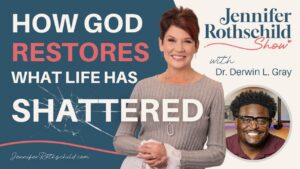
We all carry wounds and scars―some that seem like they’ll never heal or go away.
But in this powerful, gospel-centered conversation, Dr. Derwin L. Gray explores how God meets us in our deepest wounds and transforms our pain into purpose. Through personal stories, biblical truth, and insights into the brain, Pastor Derwin shares that God is at work even in the places that hurt most, and He’s restoring what life has shattered.
You’ll hear why you shouldn’t hide your wounds, how you can replace the lies you believe with the truth of the gospel, and how forgiveness can free you from becoming like those who hurt you.
This conversation is packed with Scripture and rich with gospel hope, reminding you that you don’t have to pretend everything is okay. Your pain gives you a testimony, and you’re never too far gone for God to heal.
Meet Derwin
Dr. Derwin L. Gray is a former professional football player in the NFL, including five years with the Indianapolis Colts and one year with the Carolina Panthers. But today, he is the lead pastor of Transformation Church near Charlotte, North Carolina and a bestselling author. He and his wife, Vicki, have been married since 1992 and have two adult children, Presley and Jeremiah.
Related Resources
Links Mentioned in This Episode
- Listen to other episodes with Pastor Derwin on being a part of racial healing or getting over feeling awkward about sharing your faith
- Get Pastor Derwin’s book, It’s Time to Heal: Four God-Given Steps to Restore What Life Has Shattered
- Visit Pastor Derwin’s Website
Related Episodes
- Can I Survive a Lifequake and Trust That God’s Got Me? With Tracie Miles
- Can I Build Up My Faith When My World Is Crumbling? With Michele Cushatt
- Can I Unlearn the Lies I Believe? With Gary Thomas
- Can I Forgive When I’ve Been Wronged? With Nicole C. Mullen
- Can I Heal From Relational Hurt? With Lysa TerKeurst
- Can I Forgive and Make It Stick? With Debbie Barr
Stay Connected
- Subscribe to Jennifer’s email list so you don’t miss an episode.
- Follow Jennifer on Facebook | Instagram | X (Twitter)
Episode Transcript
Jennifer Rothschild Show: How God Restores What Life Has Shattered with Dr. Derwin L. Gray
**NOTE: This transcript was automatically transcribed and may contain errors, misspellings, or mistranslated words.**
Dr. Derwin Gray: In a world like ours that is not yet the new heavens and new earth, there is no escaping pain. There's no escaping trauma. As a matter of fact, Jesus experienced our pain and our trauma on the cross. And so he suffered.
Jennifer Rothschild: Hmm.
Dr. Derwin Gray: But because he rose from the dead, His grace is indeed sufficient. And what happens is, is our wounds become wisdom and our scars become a testimony. And so what I want people to know is you're not stuck. Trauma may explain you, but it does not get to write your future.
Jennifer Rothschild: Welcome to The Jennifer Rothschild Show. This is where thoughtful people come to grow. And ooh, this is gonna be a good day because this is far more than a conversation about surviving pain.
This is gonna be a roadmap to healing, wholeness, and freedom. Sounds good, doesn't it? Well, today's guest, our friend, Dr. Derwin Gray, has said this, and I love it.
I want you to hear it right up front. "As a wounded healer and pastor, I count it a sacred honor to walk with you in the healing grace that God offers." Doesn't that sound good? Oh, my friend, you are about to get 4 steps to walk on this path of healing.
So, let's get started. Well, hey, friends. I hope you've had a good week.
I bet you've had a busy week because, at least in the United States here, this is Thanksgiving week. So you might've been prepping, you might've been traveling, or you might've been doing what I did, ordering your meal to be catered. That is what I learned to do 3 or 4 years ago, and it is worth every penny.
And you know what? They make very cute paper plates at Hobby Lobby. So let's do it.
That's what I'm saying. So that's Thanksgiving at our house. And you know what else I'll tell you I'm very thankful for is you.
Thanks for hanging with me, especially those of you who have always listened to the 4:13 and you've transitioned with me to the Jennifer Rothschild Show. Let me tell you, I am thankful you've hung with me, and I'm thankful that you're growing with me because this is where thoughtful people come to grow.
Now, I've been getting some questions. I thought I'd just take a second to answer. Here's the question in one form or another... Where is KC?
Well, right now he's in a turkey coma after Thanksgiving. I can guarantee it.
But I wanted just to give you a little scoop about what's going on with me and KC and what to expect. Now, nothing has happened. There is no drama. Sorry, no drama. No problem between me and KC. We're still BFFs. He's still my bro-bro. I love the man. He loves me.
But here's what happened. Our fall just blew up with busyness. And we just have not been able to coordinate recording together.
But that doesn't mean KC's not going to be back. I know you miss him. I miss him.
And we just haven't figured out how we can pull this off like we have done in the past, because honestly, my schedule got super busy. I've been doing this Hope of Heaven tour. I've been traveling with other events.
And then also this fall, Phil and I got to go to Greece and Turkey. So literally, I have been out of town more than I have been in town. So stay tuned.
Well, figure out how me and KC can get together because I know you love him, and so do I. Tell you one more thing I'm thankful for? A new baby.
Yes. A grandbaby is about to be born in our family. Our youngest son, Connor, and his beautiful wife, Chloe, they're expecting a baby anytime now.
Her name is Corinne. Won't that be beautiful? I cannot wait to hold that baby.
And I'll be honest with you, it's kind of interesting. Connor is my baby and he's having a baby and that is a whole different feeling. Some of you ladies know what I'm talking about.
Um, it's a whole different feeling. It's very special for my baby to have a baby. So I cannot wait to hold that little girl in my arms.
All right. But we're going to move on to Dr. Gray because whether you're finishing lunch, doing the dishes, getting ready to go shopping, or maybe you're in a turkey coma like my friend KC is, you're going to enjoy this conversation.
It's very pastoral. So let me introduce you to Dr. Gray.
If you're not familiar with him, Dr. Derwin Gray is the lead pastor of Transformation Church. It's near Charlotte, North Carolina. And he and his wife, Vicki, they've got 2 kids and they've been married since 1992.
He is a bestselling author of several books, including the one that we're about to talk about, It's Time to Heal. So settle in and let's grow.
[INTERVIEW BEGINS]
All right, Pastor Derwin, I'm glad to have you back with us again, and we're gonna talk about your latest book, It's Time to Heal.
And I wanna start with this, okay? Because in your book, you talk about God redeeming our pain rather than erasing it. Okay, now that's not a message that sometimes we wanna hear.
So why don't you start with that? Why is that a hopeful message?
Dr. Derwin Gray: Um, the reason why it's hopeful is because it is really the story of redemption. Redemption's a big word, and the redemption simply means this: God is setting us free from sin and death, and God has entered into our sin and took our death. But because he rose again, he repurposes our pain.
Genesis 50:20 says this: What you intend What the enemy intended for evil, God intended for good to save many lives. And that's the story of Joseph. And so in a world like ours that is not yet the new heavens and new earth, there is no escaping pain.
There is no escaping trauma. As a matter of fact, Jesus experienced our pain and our trauma on the cross. And so he suffered, but because he rose from the dead, his grace is indeed sufficient.
And what happens is, is our wounds become wisdom and our scars become a testimony. And so what I want people to know is you're not stuck. Trauma may explain you, but it does not get to write your future.
Jennifer Rothschild: Amen.
Dr. Derwin Gray: Pain may have bent you, but God can remodel it like a cross.
Jennifer Rothschild: Ooh.
Dr. Derwin Gray: And I want people to know God is for you and not against you.
Jennifer Rothschild: Yeah.
Dr. Derwin Gray: Like, like, you can get through this.
Jennifer Rothschild: Pastor, that is so good. And gosh, you, you dropped so many truth bombs right there, that your wounds can become wisdom and that God repurposes our pain. And, and I think that's so important for us because There's not only purpose in pain, but it can be repurposed for good.
So, this is some strong stuff here. And so, it's interesting. I know this is a personal message for you because you describe yourself as a wounded healer.
So, why do you say that? And how has your own struggles with pain and your experiences of healing shaped this message that you're sharing with us?
Dr. Derwin Gray: Yeah, I got that wounded healer from the great Catholic theologian, psychologist Henry Nouwen, that we are wounded, and out of our wounds, we get a glimpse into the wounds of Christ. Uh, we get a glimpse into his compassion. We give compassion for others, and we also begin to have compassion for ourselves.
And that moves us out into the world to look for hurt people, to apply the healing grace of God. And that's really my testimony. My mom was 17 when she had me.
My dad was 19. Both of them had various issues that they worked through. My grandparents primarily raised me, but I saw a lot of things.
I experienced a lot of things that no child should ever have to experience. And so football for me became a way of escape. That was one of my motivations, was to be great.
I thought that I could out-great the pain out of me, but eventually making it to the NFL, achieving all your dreams, and you still find yourself— With pain. Wounded and hurt. The money couldn't fix it.
The girl couldn't fix it. The career couldn't fix it. What ultimately fixed it was I met a carpenter, and his name was Jesus.
And he began to mold me, and he began to shape me. But it started with, I love you, Derwin, at your worst. I am for you.
I've always been for you. Not only do I forgive you, but I declare you righteous. You belong to my Father. You are— Righteous. The dwelling place of God.
And here's a big one that got me, Jennifer, was this: my worth was found in the cross and resurrection.
How valuable must I be to God that he would give the greatest gift of all for me? So that means that what he did for me is greater than what's been done to me. And then there's some football player in me too that God has used, is that when you get punched in the face, you don't stay down.
You get up. And because Jesus rose on the 3rd day, the power that raised Christ from the dead is in me. And so over the years, God has taken my trauma and has turned it into triumph.
And a big part of it is, I didn't know I was doing this, but psychologists call it cognitive behavioral therapy, where you identify the lie you're believing and replace it with truth. And so what I started doing was, I would identify the lies that I was believing that affected my emotions, that affected my behavior. And I began to say, okay, what is the lie I'm believing?
And let me replace it with God's truth. So if I feel unlovable, I go, no, I am lovable. Look at the cross.
If I feel worthless, I go, no, I have worth. Look at the cross. If I feel like there's no hope, I go, no, there is hope.
The tomb is empty. And what I began to do is I began to do what psychologists called neuroplasticity. I began to change the shape of my brain.
The Apostle Paul said, be transformed by the renewing of your mind. That affected my emotions, that affected my behavior. And in the book, I call it Christ behavioral therapy.
Jennifer Rothschild: Oh, I like that.
Dr. Derwin Gray: That the brains we have, we can change them. And so what happens is neurons that fire together wire together. And as we begin to think after what God thinks about us, we change the shape of our brains.
Our brain and are not the same thing. The brain is the hardware, the mind is the software, and the software can tell the hardware what it wants. And so the Word of God— and what I do strategically is I write about our union life in Christ.
And if I can sum it up, let me sum it up this way: the gospel is so good, it's hard to believe that everything that's true about Jesus and his humanity is now true of me because I'm united to Christ. I'm not only forgiven, but I'm indwelt. I'm not only loved, but I am the beloved.
And all of that is true. I don't earn it. I don't achieve it.
I believe it and I receive it. And so that began to change my mind and my heart and my emotions. And so I wanna help others experience that freedom as well.
Jennifer Rothschild: That is so powerful. And what I love about it, it's not just true because it's in the word, It is real. I mean, you have lived it, and what a beautiful thing.
I love that you've replaced the C in cognitive with the C of Christ, because that really is the most beautiful hope we have. And so, I'm curious, as you explain this, your path has been— obviously, that takes a little courage. So, I am curious if you have an opinion about this.
Why do you think that a lot of us are tempted just to ignore our wounds instead of actually facing them?
Dr. Derwin Gray: Well, it's because the echoes of Adam reverberate in our nervous system. And what do I mean by the echoes of Adam? When we go back to the primordial Garden of Eden, and when Adam and Eve chose to live independent of God, the first thing they did is they went and hid.
And that's what we do too, is we go, you know what, I'm gonna work longer, I'm gonna give more attention to the kids, uh, I'm gonna, I'm gonna do more serving at church, I'm gonna, I'm gonna do more pickleball, and, and I'm gonna I'm gonna do everything I can to not let God deal with my wounds because it's too painful.
And for some of us, it turns into, well, I only drink a bottle of wine per night. And, you know, the prescription pills are for my back, even though my back doesn't hurt.
Or maybe it resorts to other ways of lessening the pain, which becomes addiction. Addiction is an escape from pain. I don't want to face it, so I want to be numb.
And, um, sadly, when we don't understand grace, we think God is looking at us with a report card going, failure, failure, failure, instead of God looking at us through Jesus-shaped glasses and says, I see the blood of my Son covering you. You can come to me as you are. Jesus only heals the true version of us, which requires Honesty.
One of the frameworks that I work throughout It's Time to Heal is the book is in 4 parts, and I give an acronym, HEAL. H stands for honest about what happened to you. You can't heal what you do not reveal.
E, expect pain on the healing journey. It's gonna be painful anyway, so you might as well experience pain of healing.
Jennifer Rothschild: Right.
Dr. Derwin Gray: A stands for accept what happened to you without giving it The ink pen to write your future. And L stands for live from love, not for love. But honesty's the first place.
God, here I am, I need you. And he doesn't run away from us, he runs to us.
Jennifer Rothschild: Oh yes, he does. I'm so— I was about to ask you about the HEAL acronym, so I'm glo— uh, acrostic. I'm so glad that you shared that with us.
And it's hard, you're right, it takes courage and it's painful to be honest. So here's a, here's a nuanced question. How Do we get honest about our pain and actually name it without indulging in it?
Dr. Derwin Gray: Yeah.
Jennifer Rothschild: Becoming defined by it.
Dr. Derwin Gray: Yep. So the way we can be honest is that the gospel says this about us: you need Jesus because you're broken. Simultaneously, it says you are more loved and righteous than you can ever comprehend.
And so the way we can say, God, This hurt me. This is what happened. This is what I did.
But yet you see me with eyes of love. Yet you see me with forgiveness. Yet you see me clothed in Christ so I can be honest.
See, God is the safest place we can ever go because Romans 8:31 says God is for us, not against us. Now here's the hard part. The hard part is when my emotions don't match the truth.
Jennifer Rothschild: Yeah.
Dr. Derwin Gray: So we have to believe the truth, and our emotions will eventually catch up. Emotions are the love child of our thoughts.
Jennifer Rothschild: I love that phrase. Yeah.
Dr. Derwin Gray: And so, and so we need to hear the loving voice of our Father and affirm that in our minds so that our hearts Our emotions can catch up. And so the hardest part of this is, God, I don't feel this. But the cross and the empty tomb are not a feeling. They're an objective fact.
Jennifer Rothschild: Amen.
Dr. Derwin Gray: And, and, and through the Holy Spirit's power, as we marinate and reflect upon that fact, it affects our emotions. And, and one of my hopes and passions is I want people to think about Jesus more often. Uh, Paul says it this way: set your mind on things above, where Christ is seated at the right hand of glory of the Father.
For you have died, and your life is hidden in God in Christ. That Jesus, when he was lifted up and ascended to the right hand of the Father— doesn't mean God has an old beard. That's a Jewish idiom for Jesus is equal to the Father.
That Jesus, who's at the right hand of the Father, is living in us and through us by the power of the Holy Spirit. And we are to set our mind and our heart on him. It's like wearing new glasses where we see the world through Jesus-tinted reality.
Jennifer Rothschild: You know, I love that. When I've thought of that verse you just quoted about setting our minds on things above, I tend to stop there and think of just, You know, okay, heavenly thoughts, righteous thinking, but you're shifting it to the focus of our thoughts, which is Jesus. He is the one.
He is the one. What a freedom.
Dr. Derwin Gray: Yes, it is. And, you know, the heartbeat of the gospel is our union life with Christ. We are not just a people of Friday where Jesus died on the cross.
Jesus dying on the cross does no good if we're still spiritually dead. It's like walking into a cemetery telling people in coffins who can't hear you, you're forgiven.
Jennifer Rothschild: Yeah, right.
Dr. Derwin Gray: So, so, so we are Friday all the way to Sunday.
Jennifer Rothschild: Yeah.
Dr. Derwin Gray: Ephesians 2:4 says, but God, who's rich in mercy and love, made us alive together with Christ and seated us in the heavenlies with him. And that is Pauline language to say we are united to Jesus. He not only forgives us, he not only declares us He not only makes us forever friends with the Father, he is living in us.
The way I say it at Transformation Church to our congregation is this way: Jesus gave his life for me, to give his life to me, to live his life through me.
Jennifer Rothschild: Mm. Amen.
Dr. Derwin Gray: And so God wants to captivate our imaginations with the truth of what's happened and what happens over the years. Because God is not a microwave. You stick it in, 45 seconds, it's warm.
God is a Crock-Pot. Where he's— where we're marinating in the juices of his grace and we become flavorful, mature people, and the wounds that we have become wisdom.
Jennifer Rothschild: Oh yeah, because they're saturated with the truth of God and the love of God.
Dr. Derwin Gray: Yes.
Jennifer Rothschild: Wow! Okay, this is so powerful, Pastor. All right, you mentioned something too that I want to circle back to— forgiveness.
Sometimes that's where we get stuck. So in your book, I know you refer to a 5-step step forgiveness program. It's called REACH, R-E-A-C-H.
Um, so what is that? And you don't have to give us verbatim, but just give us the concept. I, I'd like to know what that is and how that helps us.
Dr. Derwin Gray: Yeah, yeah, yeah. Well, first of all, let me put on my pastor hat and just say, um, I know that there's some of us who have gone through some things that hurt
Jennifer Rothschild: Hmm.
Dr. Derwin Gray: Some unspeakable things. And so I don't want you to hear me saying, um, this is easy, um, get over it, because that's not what I'm saying. What I'm saying is that Jesus is in solidarity with you and that he hurts with you and that he understands.
So the first aspect of REACH is from Dr. Everett Worthington, and he's kind of an expert on forgiveness, right?
Jennifer Rothschild: Mm-hmm.
Dr. Derwin Gray: And so this aspect of REACH is walking through the process of really internalizing what happened to you And, and how it happened. You know, in the acronym REACH, the one that I really want to focus on is the letter E, which stands for empathize with the person who hurts you. That is big-boy, big-girl Christianity.
Jennifer Rothschild: Yeah, it is. Yeah, it is.
Dr. Derwin Gray: And what happens is it, it doesn't mean that what they did to you Was not wrong. But what it does mean is you begin to empathize with the person who wronged you. When you and I forgive, it may not change the person who hurt us, but it will prevent us from becoming like the person who hurt us.
The dark powers use unforgiveness in our life To make us ruminate on the wound, and it becomes an infection, and then it begins to infect our souls. And so when we forgive, we're letting someone out of a prison, and that someone is you and me. When we forgive, we are embodying how God forgave us.
So let me give you an example of what I mean by empathizing with the person who hurt you.
So my dad, uh, was pretty much out of my life by the age of 6, and he had his own issues of substance abuse, all types of things. So, so I felt like he abandoned me. And at age 13, he showed up to a basketball game, came in the locker room after the game, put his hands up against the wall, or his arms, and you could— his shirt sleeve rolled down and you can see heroin tracks crisscrossing up and down his arms.
The coach and I made eye contact like we didn't see each other. And at that moment, I decided, I hate you. I don't want you a part of my life.
I'm gonna show you I can make it without you. Well, some people will say, well, Derwin, that seemed to work. You made it to the NFL.
But what I say is, what profit a man or a woman if you gain the whole world but lose your soul? I may have been successful in the NFL, but I wasn't successful in my soul. I was still hurting.
But in 1999, I had retired from the NFL, and I was writing family and friends letters about how wonderful Jesus is, and he's the greatest, and he'll forgive you. And I heard a voice that said, forgive your father.
And the next thing I know, Jennifer, is I was on my office floor in a puddle of tears, crying and cussing, saying, my father doesn't deserve me to find him. Where was he when I was abused? Where was he when I needed to learn how to be a man?
Where was he when I needed him? He doesn't deserve me finding him. And it was like, okay, you're being honest with God now.
Jennifer Rothschild: Yeah.
Dr. Derwin Gray: It was like God saying, okay, son, now we can do some deeper work. It was like he put me on his lap, put my head against his chest, and said, get it out, son. But never forget this.
You're right, your dad does not deserve you finding him and forgiving him, but you didn't deserve my son Jesus finding and forgiving you.
Jennifer Rothschild: Oh.
Dr. Derwin Gray: Go find your dad. So found out he was in prison. I wrote him a letter.
It was very short. Dad, I love you. Dad, I forgive you. Dad, you've got 2 grandkids that you need to know.
A few weeks go by, I get a letter from prison where he was. And before I even open it, I'm weeping, I'm crying, I'm shaking.
And I open it up, I'm moving the tears off my eyes so I can read it. And it's— and he writes back, he says, son, thank you for forgiving me. I wanna know my grandkids.
And then he said the words I'd never heard him say. He said, son, and I love you. And I just wept and I wept and I wept and I wept.
Jennifer Rothschild: Yeah.
Dr. Derwin Gray: Now here's a couple things. Number one, I resolved that God the Father's love was enough regardless of what my dad did. Number 2, when I forgave him, I developed an empathy for him.
My dad was one of 17 kids. My dad was the son of an abusive drunk. My dad was wounded.
Most people who have substance abuse issues have underlying mental health issues. So I don't know all the trauma he went through, but if I would've not forgiven him, that trauma would've continued to pass. Forgiveness broke the back of trauma.
And we reconciled. Was it perfect? Of course not.
But we reconciled. And when I talk about REACH, the E is empathizing with the person. And I want to be very clear, if someone abused you and broke the law, you can still forgive them and empathize with them, but they need to go to jail.
Jennifer Rothschild: Amen. Yeah, yeah. Well, Pastor, I, uh, number, number one, thank you so much for sharing this.
I mean, it's so powerful. I'm, I'm fighting back tears, and it is a reminder that we forgive just as God in Christ forgave us, which was 100% unmerited kindness.
Dr. Derwin Gray: Yes.
Jennifer Rothschild: And it does— I remember Stormy Omartian used to always say, forgiveness doesn't make the other person right, but it makes you free. And it's clear the Son has set you free, and you are free indeed. And I love how you're liberating so many with what God has done in your life.
So thank you for your stewardship of the pain, the stewardship of the healing. I'm so thankful for this book. I know it's going to be a companion on someone's path of healing.
We're going to get to our last question though, Dr. Derwin, and I can't wait to hear your answer because everything you have said has been so rich with the truth of God. So I don't know how you're going to top anything you've already said, but because this is the podcast where thoughtful people come to grow— oh, you're clearly such a thoughtful man of God, and I'd like to know, what is it?
If you can just give us a couple of things or one thing even that has really helped you grow. What is it? What can you leave with our listeners?
Dr. Derwin Gray: What I would say, the one thing that I think helps me grow the most is recognizing to stop thinking about me and think more about Jesus.
I grow most when I don't focus on growing and I focus on the grace of God, the mercy of God, the kindness of God, the goodness of God, the righteousness of God, the reconciling power of God, that I'm temple of the Holy Spirit, that I'm a part of the body of Christ, that Christ indwells me. That's what makes me grow.
So yes, I'm a, I'm a New Testament scholar. I got a doctorate, man. I dig all that stuff.
But here's the deal though. The greatest thing I've ever learned is this: Jesus loves me, this I know, for the Bible tells me so. Little ones to him belong, for we are weak and yay, he is strong.
Jesus Loves me. And the more I get my mind off of myself and on him, the more fruitful, joyful, powerful, and productive I am.
[INTERVIEW ENDS]
Jennifer Rothschild: Oh, my friends, wasn't that beautiful? I loved the answer he gave to my last question. He said, I grow most when I don't think about growing, but instead when I just think of Jesus.
I just, man, I love that so much. Um, what a beautiful and simple way to grow. Just think about Jesus.
Derwin says he likes to think about his power, his love, and his acceptance. Wow. He said, the greatest thing that I have ever learned Is Jesus loves me.
Okay. I got nothing else to add to that. Like enough said.
Yeah. That is the greatest thing he's ever learned. That is the greatest thing you and I will ever learn.
Jesus loves us because Jesus is love. So, all right, my friends, go to the show notes because I know you're going to want to get a review of this conversation. Read the transcript.
There's somebody you want to share this with. And I know you do also. Of course, I'm always asking you for your feedback and reviews because we really want to make the Jennifer Rothschild Show something that serves you well.
So whatever platform you are listening on, Share the podcast, leave a review, do your thing. Just know I am so thankful for you. I hope you have a wonderful week transitioning into the most beautiful season of the year where we celebrate Advent.
So keep growing, my friend. I'll see you next week.
Sign up to receive email updates
Enter your name and email address below and I'll send you periodic updates about the podcast.
