


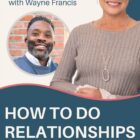

Did you know friendship isn’t just a social add-on or an emotional luxury? It’s part of God’s blueprint for life. So how do you build meaningful relationships in a world where we’re more relationally disconnected than ever?
Pastor and speaker Wayne Francis joins me to explore how Jesus modeled friendship—and what His example can teach us about doing relationships well.
Drawing from Scripture, lived experience, and years of ministry in New York City, Pastor Wayne explains why meaningful friendship requires vulnerability—which can sound very scary, especially if you fear rejection, struggle to trust, or want to stay in control. But when your security and identity are rooted in Christ, it’s not as risky as you may think.
We talk about what it takes to move beyond surface-level connections, how to take the first step toward deeper friendship, and why vulnerability is worth the risk—even when it feels uncomfortable.
So settle in, and let’s learn how to do relationships like Jesus.
Meet Wayne
Wayne Francis is the lead pastor of The Life Church: New York (located in a suburb of New York City) and is part of both The Life Church and the Association of Related Churches network. Francis is a prolific speaker at churches, conferences, and events and is also a chaplain for the Brooklyn Nets. Francis and his wife, Claudene—whom he calls Classy—have been married for 27 years and have 2 beautiful daughters. Francis loves to cycle and takes great pleasure in turning any floor into a dance floor.
Related Resources
Links Mentioned in This Episode
- Get Wayne’s book, Make Friends with Anyone: Practicing God’s Design for Real Friendship in a Lonely World
- Visit Wayne’s Website
- Jennifer Gets a Tattoo! Watch the video on Facebook or Instagram
Related Episodes
- Can I Stop Feeling Lonely? With Alli Patterson
- Can I Build Meaningful Friendships in My Busy Life? With Bailey T. Hurley
- Can I Figure Out Friendship as a Grown-Up? With Lisa Whelchel
- Can I Choose Community Over Self Reliance? With Heather MacFadyen
- Jennifer Spills the Beans With Her BFFs On How To Do Friendship
- Can I Love My Neighbor As Myself? With Jada Edwards
Stay Connected
- Subscribe to Jennifer’s email list so you don’t miss an episode.
- Follow Jennifer on Facebook | Instagram | X (Twitter)
Episode Transcript
Jennifer Rothschild Show: How To Do Relationships Like Jesus with Wayne Francis
**NOTE: This transcript was generated by AI and may contain errors, misspellings, or mistranslated words.**
Wayne Francis: It's the vulnerability that I think allows us to resonate with his work. So there is a theological framework of saying, I am who I am in Christ, and that I live to please him.
And I'm not going to just kind of divulge every part of me to people that aren't worthy of getting that level of exposure. There is some TMI at certain places, but living in the authentic place that my validation doesn't come from you and external resources, it comes from The Holy Spirit's activity in my life and His endorsement and seal on my life.
Jennifer Rothschild: Hey friends, welcome to The Jennifer Rothschild Show. Do you know why you're here? Because this is where thoughtful people come to grow, and you're a thoughtful person.
And so I'm glad you're here because, ooh, we are going to grow today. So let me start with a question. Don't you want meaningful relationships that build you up?
And don't burn you out? Mm-hmm. Me too.
Well, today, pastor and speaker Wayne Francis draws from scripture, lived experience, and years of ministry in the heart of New York City to show that friendship, it's not just a social add-on or an emotional luxury. It's part of God's blueprint for your flourishing. Ooh, this guy, he is so delightful and he's deep.
So settle in and let's grow. Well, hey friends, I'm so glad you're here. You picked a good day to pop in on the Jennifer Rothschild Show.
And by the way, can I just say, as we get going here, uh, if you have not yet left a review, please do. I really want to hear your heart and know what you're thinking, how this is serving you and ministering to you. So please leave a review, an honest one.
Well, if you want to be super honest and it's not positive, just email me, please. But if you got something fairly decent to say, say it in public. Okay.
On whatever platform you listen to, please leave me a review. But I truly mean this. I want this to serve you well.
Also share the podcast. Please share it, share it on your socials, share it with your people. Because I do this for you and I want it to multiply the message, not just of what God has given me, but y'all, there are so many amazing Brothers and sisters who God is using that I get to have really thoughtful conversations with.
And I want them to be shared because these are God's people and we're his family. So let's encourage each other. I happen to be— speaking of the family of God— I happen to be in Michigan right now on the road.
Well, or on a ferry, I should say. Mackinac Island in Michigan. It's a women's retreat that I'm doing.
And next week when I get home, please Please, please pray for me if the Lord leads you and reminds you, and I pray he will remind you. I am filming my next Bible study, the teaching portions. The Bible study is on Jesus, literally.
No, like, that's the title. Like, everything I write eventually involves Jesus, of course, but this Bible study is literally called Jesus, and the subtitle is Walking with Him Through the Library of Scripture. So I finished the manuscript, and now because it's a video-enhanced Bible study, I will be filming all 7 teaching sessions live in Springfield, Missouri.
So I know this is last minute for you, but if you're nearby, come on. It will be an encouragement. You'd be in the live audience.
You'll show up on film, you know, so wear your lipstick, but it'd be so fun to have you there. It's going to be really special, but I, I really want to represent him well. I mean, my goodness, he saved our lives.
I want to represent him well. So please pray that he gives me clarity of mind and the perfect words to teach so that he is represented well. All right.
I'll tell you somebody who represents him well. And that is my guest today. I had never met him before, and y'all, what a fun guy!
Like I just really when you hear this, you'll hear clearly. I resonated with him. I grew up in Miami, and like he is so New York, and I had a lot of New York friends in Miami, and so like I resonated immediately.
I went right back to my roots. But Wayne Francis, he is the lead pastor for Life Church New York, which is located in Westchester County. And besides pastoring and being like an amazing speaker and teacher, he's also the. chaplain for the Brooklyn Nets.
Very cool, right? He's married to Claudine, and I love this, he calls her classy, and he has 2 beautiful daughters. So you're gonna really love this conversation.
So settle in and get ready to enjoy what Wayne Francis has to say. All right, Wayne, I'm super glad we're gonna be talking today about your book, but before we get there, I just read in your bio something about you that I have got to ask. It says you take pleasure in turning any floor into a dance floor.
Okay, I gotta know more. Do you like to dance? What's up?
Wayne Francis: I love dancing. I think dancing is a great way for us to release whatever sorrows or complicated thoughts that we have. Nobody thinks a whole lot about the issues of their life when they're dancing. You're just having a good time.
Jennifer Rothschild: Yeah, I agree. I'm, I'm a terrible dancer and I love to dance. Oh my gosh, I love it.
I love it. So you dance with your wife or do you just do your own little boogie on the kitchen floor? What do you do?
Wayne Francis: Oh, I do. I dance with my wife. I dance with my kids.
I dance to anybody that's around. I'll, I'll drop it like it's hot, pick it back up like it's lukewarm. I'm 51 years old, so it's dropping it like it's hot is a little bit more lukewarm, but I get it popping. I love it.
Jennifer Rothschild: Spoken like a true New Yorker there. I love that. Okay, you're very— this— that's, that's so fun.
That says a lot about your personality, and I love it. Joy, joy, joy.
Wayne Francis: Yeah, yeah, yeah, yeah.
Jennifer Rothschild: All right, so we're going to talk about something that sometimes is a more tender subject because we're talking about friendship, and your book is called Make Friends with Anyone. Okay, now before we even talk about friendship and loneliness and all the things, your book is called Make Friends with Anyone. I'm curious, why didn't you call your book, Make Friends with Everyone?
Wayne Francis: You know, that's fascinating because when I was going back and forth with our editor, that was actually the original title. But we felt like that was overwhelming because sometimes relationally, it's very hard to make friends with everyone. But it's more accessible for a person to say that I can make a friend with anyone.
That's more strategic and focused because it might not always be healthy to make friends with everyone around you, but you should have the capacity to make friends with anyone.
Jennifer Rothschild: Okay, I like that. I like that. And I like that it reduces the overwhelm, but it becomes this beautiful invitation.
And we need it because we don't have to talk about stats right now to know that loneliness is an epidemic. I mean, people are lonely.
Wayne Francis: Mm-hmm.
Jennifer Rothschild: And so I'm curious, when you think of loneliness, do you think it's more about just a lack of people, or do you think it's A lack of meaningful people in people's lives? What, what do you think loneliness is? What's the root of it?
Wayne Francis: I actually think it's the third option, which is the lack of connection to meaningful people, because I think that sometimes we're surrounded by meaningful people, whether that's our family members, our spouses, people that we go to work with. But I think we lack the ability to connect with vulnerability and safety.
And so we are more digitally connected than we've ever been, but more relationally disconnected than we've ever been.
And so we're We're in full rooms, we just don't have a full soul. We're obese on connections, but we're anemic on depth. So I think that's where we're at.
Jennifer Rothschild: Okay, so you mentioned 2 words, vulnerability and safety. Is it because we're nervous about being vulnerable, or we don't feel safe, or both, or either?
Wayne Francis: I think it's actually both, right? There's so much at risk right now in terms of being, you know, there's this sort of challenge to being your true authentic self in some ways, or divulging the parts of us that aren't as pretty And so vulnerability usually leaves people with what I call a vulnerability hangover. You're like, oh dude, should I have said that to them?
I don't know what they're going to do with that information. Because so many of us have had the safest parts of us weaponized to either manipulate us or to control. And so it is a little bit scary sometimes to dive into a relationship with a person based on vulnerability.
Jennifer Rothschild: Yeah, 100% agree. And there's this weird tension between Ah, we can still be honest with people without being so thorough.
Wayne Francis: Right, right, right.
Jennifer Rothschild: That we compromise privacy or things like that. I mean, and there's a difference too between privacy and secrecy. I mean, it's just this weird nuanced thing.
So no matter— no wonder a lot of people just are like, okay, it's easier just to, you know, send somebody a text or relate online where I can control. Um, how much do you think control, a sense of control, has to do with, um, this loneliness epidemic?
Wayne Francis: I think, um, it plays a big role because we're all optical illusionists that want to convey the fact that we're okay and that we're not hurt. We're Teflon, we're this, we're that. And yet that's the barrier to— and this is why we exhale when we meet that person that does just drop it like it's hot in some, you know, random restaurant or whatever, because they seem so free.
We all want to be free. We all want to be the best version of ourselves that aren't grabbing the fig leaves like our first parents did after they You know, committed the first sin, right? We want to go back to the proverbial Eden where we can be what I would say is emotionally nude with people, where there is no shame, where we're at a place where we can say, hey, this is how I'm feeling. This might not be accurate or true, but we're whiteboarding in a way where it's safe in front of the people that we love and that are near us.
Jennifer Rothschild: Okay, that's good. That's interesting. And so as I hear you describe that, and we're going to get a little more into the nitty-gritty of literally doing friendship, but I'm curious about -- just theoretically, is it our safety in God, our security and identity in him, that kind of sets us up for success in this area? What is it theoretically on the more global scheme that allows us to take that vulnerable next step?
Wayne Francis: I actually think that's a really great question, Jennifer. I think that is a theological framework that we have to kind of wrestle with. Because if we look at the writings of the Apostle Paul, who I think is one of the most vulnerable leaders of all time, particularly in the New Testament, listening, he's kind of like, yeah, I used to be this real bad guy.
I persecuted the church. He was so aware and self-aware of allowing himself to be vulnerable. Think about how he wrestles publicly with people throughout millennia to say, hey, the good that I would do, I, I don't do it because evil presents itself.
Oh, I'm such a wretched man, right? That is vulnerable. I mean, you are the Apostle Paul, dude, and you're talking about you struggle with sin like me.
But it frees all of us to enter into this space when he says things like, man, I prayed and 3 times I deny it. It's the vulnerability that I think allows us to resonate with his work. So there is a theological framework of saying, I am who I am in Christ, and that I live to please him.
And I'm not going to just kind of divulge every part of me to people that aren't worthy of getting that level of exposure. There is some TMI at certain places.
Jennifer Rothschild: Sure.
Wayne Francis: But living in the authentic place that my validation doesn't come from you and external resources, it comes from the Holy Spirit's activity in my life and his endorsement and seal on my life.
Jennifer Rothschild: I love that— his endorsement and seal on my life. I'm so glad. I've never thought of— well, first of all, I've never thought of the blustery Apostle Paul as vulnerable.
But you're absolutely right. He is. And I love to see even just talking about him shows us, Wayne, that strength and vulnerability.
But yeah, when we're positioned, endorsed, sealed, signed, it's done. Nothing. We risk nothing.
Wayne Francis: Which is so interesting. Because if you compare his personality, the Apostle Paul, to let's say to Peter. Peter, who seemed to be pretty vulnerable in the New Testament, like in terms of saying what was on his mind, like what was on his mind was out his mouth.
In his writings, he doesn't really get vulnerable about what he did. You never hear him say in the epistles like, hey, I, Peter, the one who denied Christ 3 times, like he doesn't do that. And yet you look at Paul and Paul's just letting his stuff out. And I think that there's the beauty of different personalities.
Jennifer Rothschild: Yeah, it is. It is the different personalities. And it's also such a beautiful paradigm to think, okay, when we're safe in God, we can risk with others.
And we're not going to step into the ocean until we realize that we can risk. And so, okay, that was an obvious transition since, you know, your book, but that's what I want us to do. I want to go into the ocean.
Wayne Francis: Okay.
Jennifer Rothschild: Because you've got this cool framework. I think there's 5.
Wayne Francis: Yes.
Jennifer Rothschild: Yeah. Show us the different types of relationships based on this paradigm you created, this framework.
Wayne Francis: Yeah. This is a rubric that I think is so useful for us to figure out how to stratify our friendships. Bit of a nod to the way that Jesus even stratified his friendships.
But the first level in this, uh, rubric is we have sunbathing relationships. That's the surface-level relationships where you talk to the other mom that's at the bus stop with you as you're picking up your kids. It's the barista at your local coffee shop.
You don't get deep with them, but there's sunbather relationships, and it's great to just chat and talk about things that are casual. The only problem is if you stay on the surface too long, you get sunburned. So the second relationship level that I talk about in the book is surfers.
Surfers are the people that seem to come into your life on the waves of life, the rhythms of life. They recede with the ebb and flow. So these are the friends that celebrate you when the graduations happen and the weddings, but you might not talk to them for about 3 or 4 months. But most people that are surfers would say this about this type of personality: we just pick up where we left off.
Jennifer Rothschild: Yeah.
Wayne Francis: Those are the type of friends that they just roll in and they roll out. The next level is a snorkeler. A snorkeler is a person that you can get a little bit under the surface with.
You might tell them about a couple of things that are bothering you. You might get a little bit more vulnerable, but certainly you're still protected. You're just seeing some parts of their world, and they're seeing a part of your world that's a lot more different that you couldn't see from the sunbathing level, and you couldn't see from the surfer level.
But the relationships that mostly endear many of us, or at least that is aspirational for us, is the Uh, snorkeling level. Snorkelers are the people that you go deep with, man. You have apparatus, you're getting down and dirty.
They're knowing about your problems, your heartaches, that your husband is getting on your nerves and so are your kids, that you're— you've been betrayed and backstabbed. They know some things about your childhood traumas and all that. And the interesting thing about scuba divers is that if you both pull out the relationship too fast, you'll get the bends.
So you stay committed. The last level of relationships that I think is fascinating is the submarine level. This is the deepest level of relationship.
This is the people that you have mutual destruction with because you are willing to go into the depths and you are totally vulnerable, totally in a place where you share the most exclusive type of friendship possible. The beautiful thing about a submarine relationship though is that it's the only one where you can enjoy every level because submarines can float toward the top and it'll be okay, and sometimes you can get a little bit lower and go deep. It's one of those relationships that is the safest, but you got to be careful because not everybody can be at that level of depth, and you can't confuse— you can't give submarine access to people that are sunbathers. It's a— there's a strategic way of connecting with people.
Jennifer Rothschild: Wow. Okay, that is so good. And I know just like I was listening, others were analyzing the people in our lives and who we are in their lives.
And so that's really good framework. Okay, so what have you found though, especially understanding kind of what you just shared with us, what have you found that What's to be the most like challenging part of making these intentional or meaningful relationships, maybe toward the snorkeling, getting down to the diving to the submarine level? What is it? Yeah, it's hardest.
Wayne Francis: I think giving people trust to go there and the idea of, you have to be okay with not always receiving the reciprocity that you might intend. You have to take a risk to get to those levels of relationship. And I actually have in the book, a friendship audit where you can Yeah.
And you can actually take a quick test, sort of similar to the Enneagram or Myers-Briggs or anything, to find out what type of natural propensity you have in relationships, which will help you on how you relate to other people. But basically, it takes trust. You got to trust the apparatus.
And too many of us, we keep floaties on for safety to just kind of wade around them. But if you see an adult with floaties on in a pool, there's something wrong with that, right? Adults should learn how to take the risk to swim.
And I think that's the most important thing. takes risk, and you will get hurt, and you do have to reorder friendships. There is no sort of like nirvana toward relationships. You're gonna get hurt. Jesus got hurt.
Jennifer Rothschild: Yeah, I didn't even think about that, but you're right. He was betrayed. And whoo, okay, so interesting, Pastor.
And I, I love this because I'm glad you've written it into the book because this is the kind of thing we don't just glean in a 30-minute conversation on a podcast. I'm glad we can go deeper in the book. But one thing that strikes me just as a pragmatic point, someone listening right now, and she's into friendships, of course, but I'm curious, how would you recommend that she honors her marriage, but still cultivates meaningful friendships outside of her marriage?
Wayne Francis: Yeah, that's a great question. Because I think that there is something that happens. And this sometimes is not the most popular thing.
Because I hear spouses say, well, this person is my best friend, or my husband's my best friend, or my wife is my best friend. And I actually think that that's possible and beautiful in its own respect. But I also think that it's limiting.
I actually think that couples should have somebody of the same gender that is their close friend, because it's a different type of relationship. And God has made it so that we need relationships. They're oxygen.
They're not optional. And I think sometimes we can hide the parts of ourselves in this kind of like, oh, my spouse is my best friend thing, when we actually need to know certain things about a person through somebody else. God has made it a 90-degree angle. There are things— my wife has been in perimenopause— that I can empathize with, but she gonna need some girlfriends, right?
Jennifer Rothschild: You can't help her with that.
Wayne Francis: I can't help you with that, right? And there's certain things that the male soul needs affirmation through that my wife may not be able to supply. That doesn't mean that it's a lesser relationship.
It just means that God has made us to experience the best and the worst out of each other, and we cannot experience the best of God without the best and worst of each other. And that can't be in a marriage context. We have to be discipled by people that are different than us.
Jennifer Rothschild: Amen. Listen, that is such a good word, and I hope my girlfriends out there have heard that. You know, my— I love my husband.
He is a stud, but he's not my BFF. I mean, I've got girl BFFs, and he would not want that job. It's a lot.
Wayne Francis: It's a lot, right? I know sometimes it's unpopular, but sometimes it's a, it's a safety measure because people are afraid to be vulnerable with somebody that they're not covenanted with financially, emotionally, children, and so on and so forth. It's because it gets scary.
Jennifer Rothschild: Yeah, right. Well, and I know this, Wayne, I'm a better wife because of my girlfriends. Yes, I learned from how they relate to their husbands, and I'm not gonna, you know, gain that from my husband being my one and only BFF for the rest of my life.
Wayne Francis: Right, right.
Jennifer Rothschild: Um, yeah, iron sharpens iron. So I'm curious about you personally, like, what is the most unusual way that you've ever made a friend?
Wayne Francis: Oh, wow. Well, you know, I've done so many different things. Like, I've slid into the DMs of a pastor that I wanted to learn from and just texted and said, hey dude, can I have lunch with you?
Jennifer Rothschild: Nice.
Wayne Francis: Um, because I'm a new church planter and you look like you're doing something great. I'm the guy that you don't want to sit next to on an airplane because I am going to talk to you. Put your earbuds in because I'm gonna make a way to have a friendship with you.
But usually I am so into making friendships that I am constantly talking to people. I'm curious about humans, about what they're wearing. I live in New York City, obviously, and it's like there's fashion and there's art and so on.
So I don't know if there's anything more unique. Oh, I made a friend after I broke my arm. That's a pretty unique way to make a friend.
And I just saw him on the street. Hey, yes, I broke my arm cycling last year.
Jennifer Rothschild: Oh.
Wayne Francis: And it was a great opportunity to make a friend with the EMS team. He literally came to my church about 2 days ago. It was Sunday and came to say hello and to check on my arm.
Jennifer Rothschild: I love that. I love that. So there's, there's plenty of avenues, but I'm curious what you would say.
In fact, we've only got a couple more questions here, Wayne, but I'm curious what you would say. So clearly, I mean, I would assume you're either a learned extrovert or you're a natural extrovert, but you talk to people. Okay.
Wayne Francis: Yes.
Jennifer Rothschild: Some people aren't quite that wired. To the one who struggles to begin relationships, like, and she may feel isolated. What, what can you tell her? What would be a good first step for her?
Wayne Francis: The first step is to— you're gonna have to be okay with not feeling reciprocity or received, right? Like, somehow you have to dull the piece of us that is like, I don't want to be rejected. And you have to do it in your head first before you actually engage in a relationship.
Then the second thing is, I think introverts need to not worry about quantity. I think they need to just focus on one and let the one multiply in the way that it needs to. I think we don't need many friends in terms of like, uh, you know, 15 or 10 friends.
We need to take the courage to develop one, one that we can be vulnerable with. Because what happens is when we get into those relationships and we let those walls down and we get connected, it makes it easier for the next one. We become less resistant, we become less calculated.
Introverts tend to be a little bit more calculated, like, I just don't want to do that. Uh, That's odd. That's weird.
I think you just focus on uniting with the personality type that you feel most comfortable with, which probably isn't the opposite of you. It's probably somebody that's more like you.
Jennifer Rothschild: That's, that's a good word. And I happen to be an introvert, which because of what I do, people are usually surprised by that. I've just, I love people and I'm curious.
So it translates as extroversion. But I will say, I've had seasons in my life, Wayne, where I've thought, okay, I literally have to change my mindset. set. People are gonna like you.
Act like they're gonna like you. Just go in with confidence and assume that they're gonna like you, because introverts overanalyze, you know?
Wayne Francis: Yeah.
Jennifer Rothschild: So that's—
Wayne Francis: We overcalculate.
Jennifer Rothschild: We do. It's such an interesting, um, observation you made. And I remember even as a little girl or teenager, I was starting to date and I was such a nervous wreck.
And my dad was like, okay— he sat down with me, precious dad. He sits down with me, he says, okay, here's 3 questions that you can ask anytime you have any kind of new relationship, and, and it just gets the ball rolling.
Wayne Francis: Yeah.
Jennifer Rothschild: Um, and honestly, I think sometimes we need to be that pragmatic, you know?
Wayne Francis: Yes, yes.
Jennifer Rothschild: Because we're reducing that sense of self-awareness when we do, I think.
Wayne Francis: I agree. And Jennifer, I like to tell people, and especially for introverts, your mindset is determined by where you let your mind sit. And if your mind is always sitting in, I'm not going to be received, I'm going to be rejected, I'm going to have this, then that's probably the way your relationships are going to But when you have a right mindset, you set your mind in the right places and it becomes easier to arrive and show up to the world in a way that's authentic.
Jennifer Rothschild: Word. Okay, good stuff. Wow.
Okay, this is— you are delightful and I just, I'm so grateful for your energy. If I were near you, I would want you to dance with me so I'd be a better dancer.
Wayne Francis: 150%!
Jennifer Rothschild: Okay, you'd be dragging this blind woman around your dance floor. You've not seen anything. Yet.
Here's our last question. All right, Wayne, so this podcast is where thoughtful people come to grow. So just leave us with something, anything you want to share with us that has helped you grow.
Wayne Francis: I think the things that, or the people that have helped me grow in the most recent cycle of my life have been the most challenging people, the people that were confrontational. I don't like confrontation. I try to to run away from confrontation a lot of times.
I want everybody to like me. I want everybody to love me. And usually a conflict delayed is a conflict escalated.
And I have had more growth with people and friends that have really called me to the mat on different things that didn't affect our relationship. Like, it wasn't me and them beefing about anything. It was like, hey, your life looks like it's moving really fast.
And, um, it looks like you're all over the place, and it feels like you're, you're not slowing down. In fact, I'll tell you how I grew recently. A friend of mine— I got my tattoo the other day.
51 years old. Exactly. And it was an homage to my grandmother and my mother.
My mother recently passed away about a year ago, and my friend was challenging me and saying that my personality is like a hummingbird, that I move around and all this stuff. And you, you know, you have this frenetic pace, which is good because you pollinate different areas, but you're also busy in a way that you don't rest. And, um, and the challenge was a gentle rebuke That has allowed me to grow and to become more settled in a new way of looking at myself.
Jennifer Rothschild: So, uh, you heard Wayne say he got his first tattoo. When we got off mic, he said, oh, it was a little awkward. I, I wasn't sure if I should have said that to your audience.
And then I told him, Wayne, I got my first tattoo also. Many of you know that I got it last year. When I turned 62, I got my first tattoo.
And he said, oh, that makes me feel so much better. Well, listen, I got 3 words on my arm that say, it is well, because that's the way I've lived my life. That's what Jesus has done for me.
And that's how I want to end my final days with those words on my lips and on my arm. It is well. Oh, it is well.
Okay. Here's a seed for thought to help you grow that I thought Wayne dropped that I thought was so helpful. When I asked him what helped him grow, He said people have helped him grow.
Isn't that interesting? People, but not just anybody. It's the ones who confront and challenge.
So be wise. I thought this was really smart what he said. Don't run from confrontation because conflict delayed becomes conflict escalated.
Now I know it's hard. I hate conflict, but I much more dislike ambiguous relationships where you don't know where you stand and where We have to stand on the eggshells to have any kind of conversation. So within these safe relationships that we have, he said rebuke has actually helped him grow.
Y'all, that's huge. That's huge. I think there's a lot here you're going to want to review.
So check out the show notes, of course, so you can read the transcript. His book will be there. Anything else that can help you grow is going to be right there on the show notes.
So thank you for sharing the podcast. Thank you for leaving a review. Thank you for praying for the Jesus Bible Study.
Man, do I love you and need you and appreciate you. You guys are the absolute best. So thanks for being a part of the podcast. Keep growing, and I will see you next week.
Sign up to receive email updates
Enter your name and email address below and I'll send you periodic updates about the podcast.
